|
For centuries, the lily has ranked as one of the most
popular flowers in the world. So popular in fact that the lily has long
been associated with both religion and death. Unfortunately lilies have
long been associated with death in Texas gardens as well, as most true
lilies don't thrive here.
True lilies (Lilium) are members of the lily
family. There are over 80 species of lilies worldwide. Very few are
adapted as ling lived garden perennials in Texas however. Our early
hot summers tend to send the plants into premature dormancy before they
have stored enough food reserves for future growth and flowering.
Because of their superficial resemblance to the ever
popular true lily, many members of the amaryllis family have historically
been referred to as lilies in Texas, including crinum lilies (Crinum),
spider lilies (Lycoris and Hymenocallis), rain lilies
(Zephyranthes), oxblood lily (Rhodophiala bifida), lent
lily (Narcissus pseudonarcissus), Chinese sacred lily (Narcissus
tazetta orientalis) and lily of the Nile (Agapanthus). Canna
lilies (Canna), members of the Canna family, and ginger lilies
(Hedychium), members of the ginger family, are other lily imposters
found frequently in Texas gardens.
Few true lilies call Texas gardens home. Among the
few and the proud are the Madonna lily (Lilium candidum), the
tiger lily (Lilium lancifolium/L. triginum), the Philippine
or Formosan lily (Lilium formosanum), and the Easter lily (Lilium
longiflorum).
The Madonna lily is one of the oldest cultivated lilies
in existence. It was cultivated as early as 1500 BC in Crete. It is
a native of the Balkans and perhaps Israel and Lebanon as well. Its
white flowers have long been a symbol of purity. Throughout the ages
it has most frequently been referred to as simply the "white lily."
With the arrival of Christianity, it quickly became a symbol of the
Virgin Mary. It is most adapted to the alkaline areas of Texas including
North and Central Texas. The Madonna lily can occasionally be found
surviving in Central Texas cemeteries, primarily those of German heritage.
This particular lily grows its foliage in the fall, blooms in the spring,
and goes dormant during the summer. Due to its winter foliage, it might
need periodic protection from extremely hard freezes and ice storms.
It is propagated by division in the fall.
The tiger lily is a common inhabitant of many older
gardens throughout Texas and the South. It is reported to be a native
of Korea, China, and Japan, where its bulbs have long been eaten for
food. As it is apparently a sterile triploid, some speculate that it
is a very old hybrid. It seems to thrive best in the acid sandy soils
of East Texas and the southeastern states. Its bright orange flowers
speckled with dark spots are its easily recognized feature. The tiger
lily begins growth in the spring, blooms in early summer, and then goes
dormant for the fall and winter. It produces no seed but can be propagated
by division during the fall or by planting the small bulbils (mini bulbs)
that are produced in the axils of the leaves. These should be cared
for as would other young seedlings.
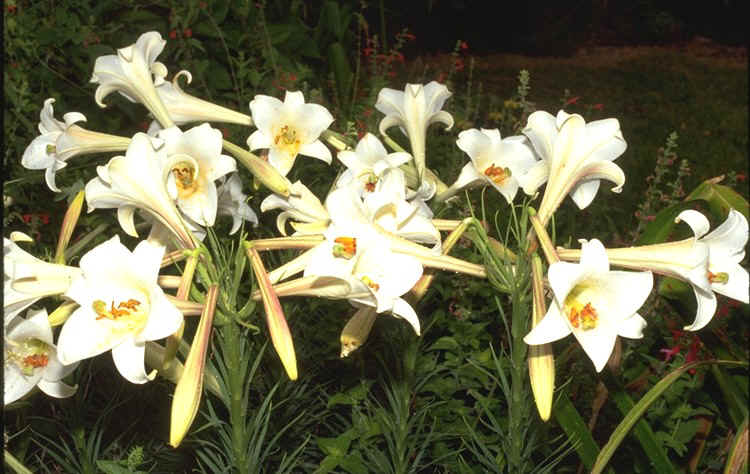
The relatively obscure Philippine lily is perhaps the
most adapted of all. It is native to Taiwan and the Philippines. It
is a very tall growing lily (3-5 feet) that produces it's cluster of
drooping, fragrant, white trumpets during the late summer. Its narrow,
grasslike foliage and late bloom time distinguish it from all other
lilies. This lily begins growth in the early spring and goes dormant
during late fall and winter. It is adapted to all areas of the state.
The Philippine lily can be propagated by division or very easily by
the many seeds that it produces. It commonly seeds out and naturalizes
anywhere from the flowerbeds to the neighboring woods. It is the only
lily that can be grown from seed to bloom in as little as one year.
The Easter lily is most commonly found in gulf coast
gardens due to its somewhat tender nature. This popular florist pot
plant is originally a native of Japan. It goes dormant during the fall
and winter, resumes growth in the spring, and blooms during early summer.
Although not supremely adapted, it's worth planting the potted ones
left over form Easter in good organic beds. More times than not they
will grow to bloom again, but not usually the next year. As flowers
bed inhabitants they will bloom during the summer as opposed to Easter,
however.
All lilies prefer sun to part shade. Really hot sunny
exposures often burn their foliage, while heavily shaded locations don't
provide enough sun for food production. Lilies tend to fall over in
shady locations as well. As a rule, most lilies prefer good, well drained,
organic soils with adequate moisture. Most garden soils can be amended
with peat moss and sand to meet these needs.
Most catalogs offer a wealth of beautiful lilies. Although
most aren't adapted to our harsh growing conditions, the adventuresome
gardener might want to try the asian and the trumpet types. Common sense
gardeners should stick to the tried and true lilies and the many common
imposters. After all, if you can't get Elvis, why not a good impersonator?
For more information on lilies, contact the North American
Lily Society, P.O. Box 476, Waukee, Iowa, 50263.
Texas Lilies at a Glance:
Madonna Lily (Lilium candidum): Pure white,
trumpets in early summer. Plant in fall. Best adapted to well drained,
alkaline soils of North and Central Texas. Moderately difficult to grow.
Zone 4.
Tiger Lily (Lilium lancifolium,L. tigrinum):
Open faced, orange flowers with dark spots in early summer. Plant in
spring or fall. Best adapted to acid, sandy soils of East Texas. Fairly
easy to grow. Zone 3.
Philippine Lily (Lilium formosanum): Fragrant
white trumpets in late summer. Plant in spring. Adapted statewide. Easy
to grow. Zone 7.
Easter Lily (Lilium longiflorum): White trumpet
flowers in early summer. Plant in spring. Best adapted to Gulf Coast
and East Texas. Moderately difficult to grow. Zone 8.
Sources:
Southern Perennials and Herbs
98 Bridges Road
Tylertown, Mississippi, 39667-9338
Phone: 1-800-774-0079/601-684-1769
Fax: 601-684-3729
On Internet's World Wide Web at: http://www.s-p-h.com/
Incredibly extensive catalog: $3.
(Tiger Lily and Philippine Lily)
Flowerplace Plant Farm
P.O. Box 4865
Meridian, Mississippi 39304
Phone: 1-800-482-5686
Email: RWLOWERY@DELPHI.COM
Good catalog: $3
(Philippine Lily)
Plant Delights Nursery
9241 Sauls Road
Raleigh, North Carolina 27603
Phone: 919-772-4794
Fax: 919-662-0370
Very extensive catalog: 10 stamps or a box of chocolates
(Philippine Lily)
McClure and Zimmerman
108 West Winnebago
P.O. Box 368
Friesland, Wisconsin 53935
Phone: 1-800-692-5864/414-326-4220
Nice catalog: Free
(Madonna Lily)
|