| SAVING SEED OF HYBRID VARIETIES -
ONCE NOT RECOMMENDED; NOW ENCOURAGED
Gardeners have faced discouraging arguments about saving their
own seed, both in what they read and from conversations with other
gardeners and horticulturists. These precautions and arguments
should have been heeded most of the time and close attention paid
to some of the obvious pitfalls, such as mentioned at: http://www.plantanswers.com/garden_column/dec04/2.htm
But desperate times call for desperate actions-if we don't save
some seed of our favorite, vanishing hybrids, they will be gone
forever. I am now going to encourage you to save seed from hybrids
mainly because of the problems we are experiencing with the commercial
seed companies discontinuing the production of the favorite Texas
varieties. All of these problems are explained at: http://www.plantanswers.com/veg_varieties.htm
Since we have tested and selected absolutely the most adapted,
reliable producing varieties for this area, if we save seed from
hybrid vegetables which absolutely "won't produce exactly
the same in the next generation", the saved seed will still
be a great deal better than other non-adapted hybrids which we
will be forced to use because of the non-availability of our favorite
hybrids.
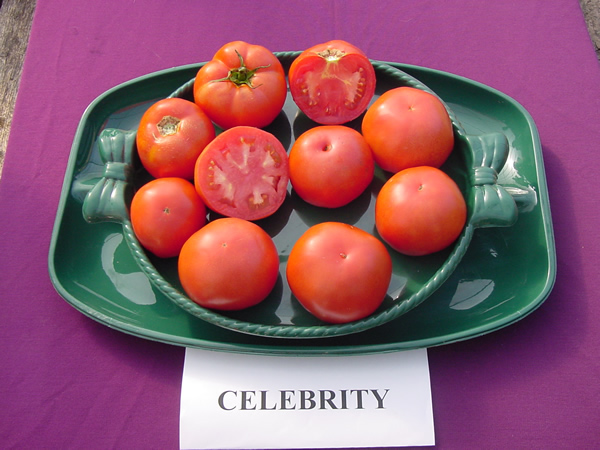
The Tomato Celebrity is not known as a heat-setting tomato
but is acceptable if fall temperatures cool early in the
season. |

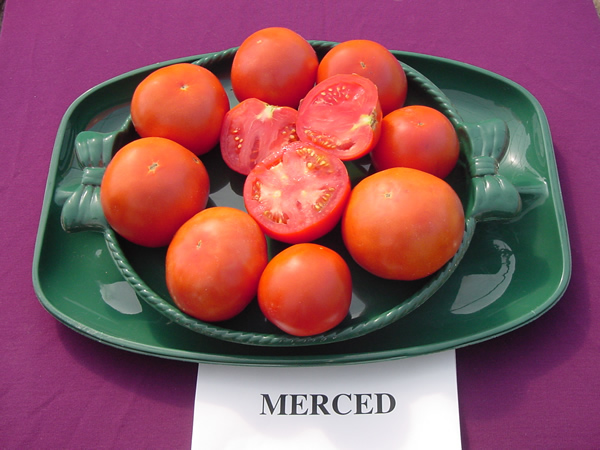
The Tomato Merced is not a heat-setter but was a favorite
of many Texas gardeners--it is no longer available. |
Granted, it is difficult for the home gardener to isolate varieties
to avoid unwanted cross-pollination. However, tomatoes and peppers
are 85 percent self-pollinated and crossing seldom occurs on the
first fruit set of the plant. If you plant only recommended varieties
in close proximity, the small percentage of crossing could conceivably
result in a better selection than the original hybrid. So to insure
optimum results, choose the first fruit which ripens on the plant
which has the qualities (yield, foliage, health, vigor, etc.)
which you want to maintain in the seedling selections. It is true
that self-pollinating a hybrid will result in the gradual deterioration
or "running out" of the original qualities of the hybrid
but, if careful selection is used, this process can take 5-10
generations.
Following are some simple directions on how to save seed from
your favorite tomato: Allow the tomato fruit to thoroughly ripen
on the vine. Cut the tomatoes open and remove the seed by squeezing
or spooning out the pulp with seeds into a non-metal container
such as a drinking glass or jar. Set the container aside for two
or three days depending on the storage temperature, i.e., the
hotter the location, the faster the fermentation. You want to
clean the pulp from the seed before the seed begins to sprout-although
some sprouting doesn't not completely ruin the batch. The pulp
and seed covering will ferment so that the seeds can be washed
clean with a directed spray of water into the fermented solution.
The clean, viable seeds will settle to the bottom of the solution,
allowing the sediment to poured off. Several rinsings may be necessary.
Then spread the tomato seed out on a newspaper to dry in a sunny,
hot location so they can dry rapidly before they sprout. After
seed are dry, scrap off of the newspaper with a blade and package,
label and date for storage in a cool (refrigerator), dry location.
Definition - What does Open Pollination mean?
Open pollination is a term that refers to plant varieties that are pollinated through naturally occurring means. These plants bear seeds that will produce plants that are identical to the parent plant. Open pollinated plants are also very genetically diverse and can be more adaptable to local growing conditions. Older strains of open pollinated plants are referred to as “heirlooms.”
Open pollination can be carried out in two different ways. The first way is through an external means such as birds, insects, water, or wind. The second way is through self-pollination, which occurs when the male and female parts are contained in the same plant.
Maximum Yield explains Open Pollination
As long as pollination occurs between the same varieties, the seeds produced will be true to the parent seeds year-after-year. This is in contrast to plants that have been cross-pollinated, which can have a variety of characteristics.
Gardeners often isolate cross-pollinating plants from different varieties so they do not become pollinated by another variety. However, plants such as beans, peas, tomato and lettuce are self-pollinating and do not require isolation. The seeds from these plant types are the easiest for home gardeners to save, as they remain “true” from year to year.
Open-pollinated, also known as heirloom or standard, plants are varieties that have stable traits from one generation to the next. Open pollinated plants are fairly similar to each other but not as uniform as hybrids. Because most were originally chosen for only one or two specific characteristics, individual plants of older heirloom varieties may differ greatly in size, shape, or other traits.
Open pollinated varieties are usually grown in fields where they self and cross-pollinate. Wind and insects carry the pollen from one plant to another. Plants that cross-pollinate must be isolated from other plants of different varieties so they will produce seed that is "true to type." Beans, lettuce, peas, and tomatoes are self-pollinating so they are easier to continue year to year without having to isolate them from other varieties of plants.
For more information and images of tomato, pepper and lettuce seed extraction/collection, see:
http://plantanswers.com/parsons_preferred_seed.htm
|