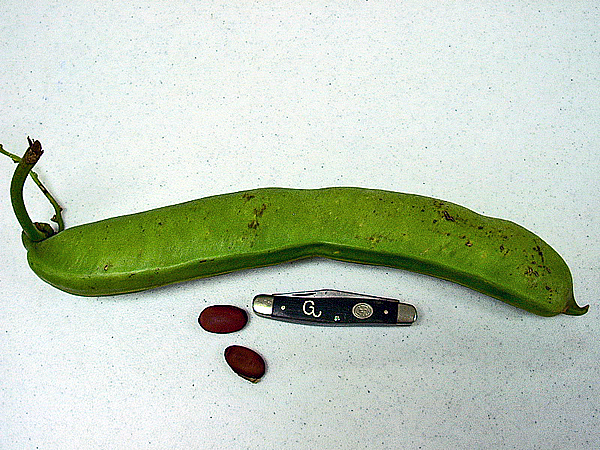
 BEAN, Big Jack Bean or Sword Bean
 |
QUESTION: A lady placed this big bean on my
desk. I have never seen a
bean of this size. She says the seed came from West Texas. She
wants
to know what it is and if you can eat it. Gideon Jennings, County
Extension Agent
=====================================
=====================================
ANSWER: This is called a Jack Bean -- Canavalia
ensiformis (L.) or in
your case, probably a Sword Bean -- Canavalia gladiata (Jacq.)
The jack bean and the sword bean are very similar. Other names
for
them are: Chickasaw lima bean, Brazilian broad bean, coffee bean,
ensiform bean, horse bean, mole bean, go-ta-ki, overlook bean,
Pearson
bean, watanka, and raba de burro.
DESCRIPTION
In both species, pods reach a length of 10-14 inches, and a width
of 1
to 1* inches. Seeds are large, *-* inch long and nearly as broad.
The
two species differ mainly in the length of the seed hilum (scar).
The
hilum of sword bean (C. gladiata) is more than one-half the length
of
the seed, whereas that of the jack bean (C. ensiformis) is only
about
one-third as long as the seed. Most of the jack beans identified
in
Texas have been white with a black seed scar, while the sword
beans have
been red seeded.
CULTURE
There probably are many varietal and environmental variations
in the
growth habit of the plants; however, it appears that the jack
bean plant
is bushy in comparison with the vining nature of the sword bean
plant.
One gardener noted that one sword bean plant covered his entire
garden
of 400 square feet.
USE
Neither bean has commercial importance in this country. Both are
reported to be edible in the young tender immature stage by slicing
and
boiling the tender pods, or peeling and using the seeds as broad
beans.
Also, reports have indicated the possibility of mild toxicity
of beans
when eaten in large quantities. Because of this, the boiling water
should be drained off to remove any poisonous substances coming
from the
beans. Pharmaceutical companies have shown some interest in the
beans as
a possible source of the enzyme urease.
Jack Bean-- Canavalia ensiformis-- is naturalized in Texas in
places.
You can see an image of the white Jack Bean at:
http://davesgarden.com/guides/pf/showimage/31447/
You can see an image of the Sword Bean at:
http://davesgarden.com/guides/pf/showimage/290581/
|