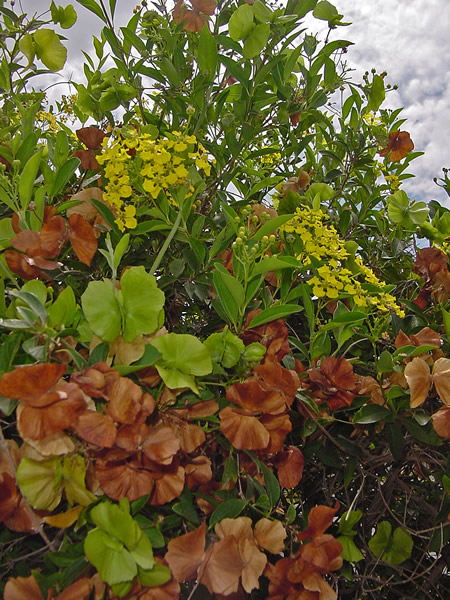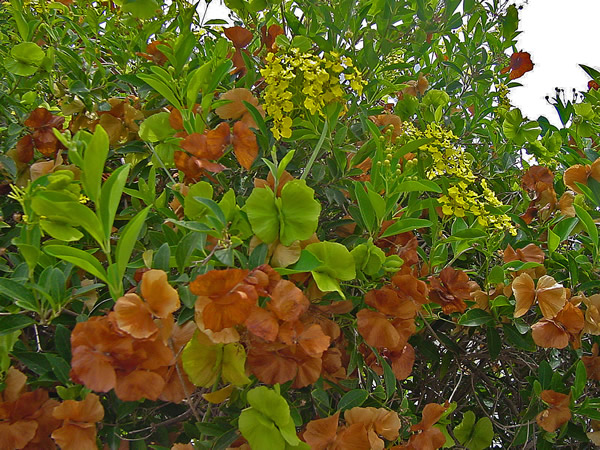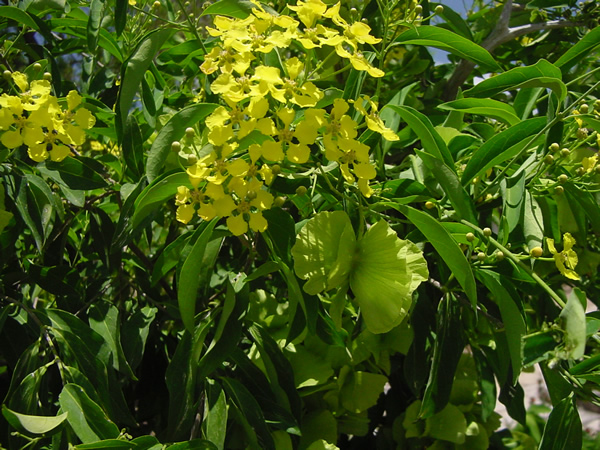
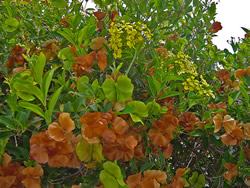
The Butterfly Vine gets its name from the seed pods which
resemble a butterfly. Notice the green (immature seed)
and brown (mature) butterfly shaped seed |
The great thing about the Butterfly Vine is it has several
maturities of seed pods at the same time it is in full
bloom. |
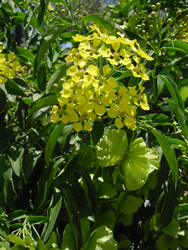
The Butterfly Vine blooms and makes butterfly-shaped seed
pods from early spring until late fall. |
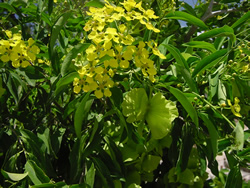
The green butterfly seed pods hide amongst the shiny green
foliage and the beautiful yellow blooms. |
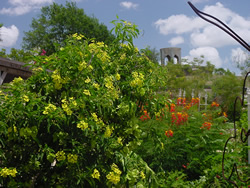
The Butterfly Vine is a summer bloomer along side the
Pride of Barbados at the San Antonio Garden. |
The clusters of dainty flowers on butterfly vine shine as brilliant
as the summer sun. But it's the seed pods that give the plant
its name.
During summer, chartreuse 'wings' unfold on the seed pods that
look like butterflies. The papery pods will turn tan to brown
as they mature, and they can be harvested and planted.
In mild winters, the vine will retain its gloss green foliage.
It will die back and resprout in spring after a cold winter.
The plant recently was renamed; it previously was classified
as Stigmaphyllon ciliatum.
Light: Sun to partial shade.
Size: 15 to 20 feet tall and wide.
Water: Moderate.
Bloom: Spring to fall.
Cultivation: Prefers rich, well-drained soil. Plant the frost-tender
vine on the south or east side for winter protection.
========================================================
Name: Mascagnia macroptera
Common name: Yellow butterfly vine. This name comes from the
greenish, butterfly-shaped seedpods the plant produces (but it
attracts butterflies, too).
Description: Fast-growing vine that reaches 10-12 feet high.
It
produces clusters of bright-yellow flowers from spring to frost.
While
many other plants are touted as spring-to-frost bloomers, this
one is the real deal. Evergreen vine that will easily train itself
to a trellis or fence. If left unsupported, this plant will twine
on itself to produce a mounding shrub or even a groundcover. This
is fairly drought tolerant but looks much better with regular
watering through the dry season.
Range/Origin: Mexico; This plant is often listed as being from
Central America but it grows as far south as Brazil. It was in
fact noted by Joseph Banks at Rio de Janeiro, Brazil (1768).
Uses: With great heat tolerance, it's well-suited for sites with
western exposures. Grow it against walls, on arbors and against
mailboxes and light posts. Another great attribute is the plant's
incredible heat tolerance. It's virtually impervious to the baking
sun and well-suited for west-facing walls and places that receive
reflected heat in summer. It's a fast grower, reaching 10-12 feet
high, and also grows in partial shade.
Maintenance: Little required
Hardiness: M. macroptera is considered hardy just to USDA Hardiness
Zone 8, but could survive Zone 7 if planted in a protected spot.
However, with its fast growth, it's also a good candidate as an
annual vine in Northern climates. It would easily reach heights
in a few months that could be enjoyed by homeowners before being
killed by winter freezes.
Propagation: Easy from seed or softwood cuttings. From softwood
cuttings, plants can be rooted and finished in just three months
-- and they can be shipped in flower. These plants can be transplanted
into gallon containers and finished in as little as two weeks.
Mascagnia macroptera
(YELLOW BUTTERFLY VINE, GALLINITA)
This native of Mexico is an evergreen scrambling or trailing vine which can easily be pruned into a dwarf shrub form. Foliage is a rich dark green which provides a contrasting dark background for the beautiful bright yellow flowers. Mascagnia blooms profusely during the summer months from May to September. Flowers occur in clusters so plants are very colorful. Each orchid-like flower has five yellow petals and may be as large as 1 inch across. Plant Mascagnia in full sun to light shade. Water to get well- established, thereafter this plant will be very drought tolerant and require little care other than pruning to shape or contain. This vine is very heat tolerant but is best adapted to U.S.D.A. Zones 8-10 since it can be damaged by severe cold. For north Texas, use as a container plant for seasonal color. Yellow Butterfly Vine can be grown on any type of support like a fence, pole or stake. It is easily pruned into a shrub and can even be used as a ground cover. The unusual fruit resembles a green to brown butterfly, thus the common name.
Questions & Answers about Butterfly Vine:
Question:
I was given some seeds of the butterfly vine and would like to know how to plant them. Can you please tell me what I need to do to encourage them to spout?
Answer:
I could not find any specific requirements for germination of the butterfly vine (Mascagnia macroptera) seed. Also I do not know how long you have had the seed or how you have stored them. I think that I would start by placing them in the refrigerator for about 6 weeks in an airtight container such as a zip-loc bag. Then I would take some of them and place them between moistened layers of paper towels, again placing them inside a zip-loc bag, and putting them in a warm location such as on a sunny window sill. After about 5 days inspect the seed daily and at the first showing of a root emerging, either plant them where you want them to grow or in 6" pot of good potting soil. Keep the soil moist, not wet and water as needed with a dilute strength water soluble fertilizer. I would take the other seed that you didn't put in the paper towels, soak them overnight in warm water, and plant them in the ground where you want them to grow. Again, keep the soil moist but not wet. They may or may not germinate. If you do not have success with getting the seed to germinate and grow, I would go back to the person who gave you the seed and ask for some cuttings.
Softwood tip cuttings will root quite readily. See this PLANTanswers Web site for instructions rooting cuttings:
PlantAnswers.com.
Question:
Can you suggest some evergreen, deer resistant vines we can plant in our yard? The area will be in the sun most of the day.
Answer:
I don't know of any that the deer will not test for taste. However a couple that you might try to see if they are offensive to your deers' tastes are: Butterfly Vine (Mascagnia macroptera) and Cross Vine (Bignonia capreolata).
Question:
I am looking for different kinds of flowering vines that grow here in the San Antonio area.
Answer:
There are a bunch of them including; Confederate Jasmine (Trachelospermum jasminoides), Butterfly Vine (Mascagnia macroptera), Coral Vine (Antigonon leptopus), Cross Vine (Bignonia capreolata), Pandora Vine (Pandorea jasminoides), Trumpet Vine (Campsis radicans), Sweet Autumn Clematis (Clematis paniculata).
Story: Bringing "Flying Flowers" to Life
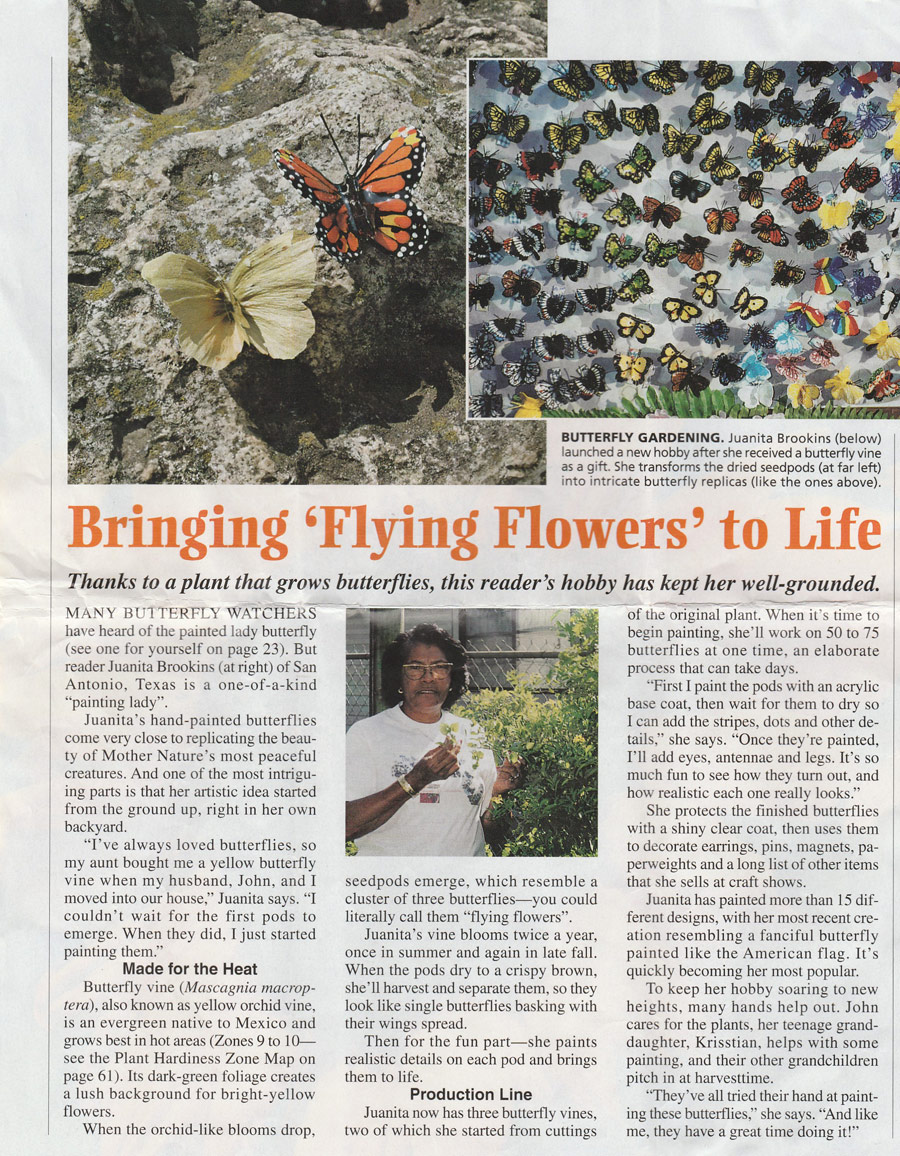 This story was in Birds&Blooms magazine about Juanita Brookins from San Antonio. It was submitted to PLANTanswers.com by Gerda from Schertz, Texas.
|