|
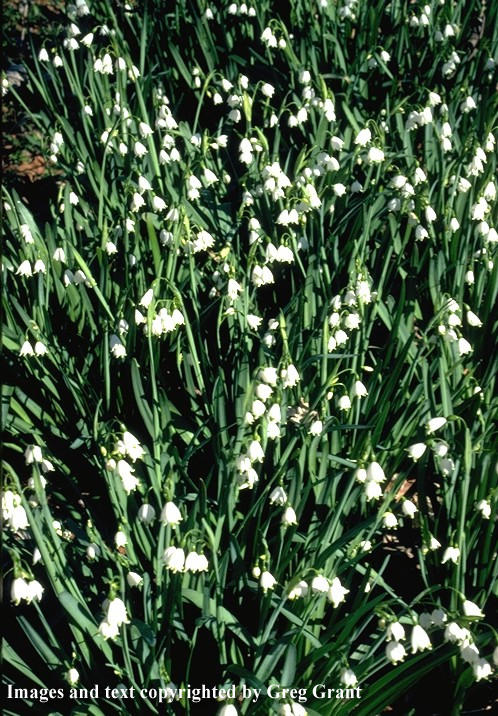
Snowflakes (Leucojum aestivum)
Greg Grant
Wouldn't it be nice if all
plants would grow in sun or shade, wet or dry conditions, and acid as
well as alkaline soils? As long as we're dreaming, how about one that
never needs dividing, never needs spraying, never needs watering, never
needs fertilizing, and lives forever too? And of course it has to be
pretty. An ugly plant just won't do. We forgot about universal. Everybody
in the state must be able to grow it. It needs to be an "equal opportunity"
plant. This is the 90's you know.
Sounds like something out
of a Sunday tabloid or the home shopping network's "plant of the week"
doesn't it? Guess what? There is such a plant...honest!
Snowflakes, with dainty
white flowers above attractive dark green foliage, are among the easiest
spring blooming bulbs to grow. Leucojum aestivum, our common
snowflake is known in books as the summer snowflake. Ironically it blooms
in early spring, generally around late February or early March. The
botanical name Leucojum is derived from the Greek leucos (white)
and ion (violet). There are also autumn snowflakes (Leucojum autumnale)
and spring snowflakes (Leucojum vernum). Neither of these is
common and reportedly don't thrive here. The violet scented spring snowflake
is dedicated to St. Agnes, the patron saint of young virgins due to
its loveliness and purity, and is often referred to as St. Agnes's flower.
Snowflakes are a member of the amaryllis family and are native to central
and southern Europe. Like many of our truly adapted garden worthy plants,
they are southern heirlooms-living antiques in a sense.
John Parkinson, the great
seventeenth-century English botanist, listed the snowflake in A Garden
of Pleasant Flowers in 1629 as the "great bulbous violet". In America
it which mentioned in most early gardening references. Early American
nurseryman Joseph Breck referred to snowflakes in The Flower Garden
(1851) as "great snowdrops" while Henderson's Handbook of Plants
(Henderson, 1881) and Bulbs and Tuberous Rooted Plants (Allen,
1893) both called them "among the most desirable of early bulbs." In
her classic Adventures with Hardy Bulbs (1936) Louise Beebe Wilder
also calls them "among the most worthwhile of spring flowering bulbous
plants." Obviously, this plant is pretty good or early garden writers
were plagiaristic (possibly a combination of the two).
The snowflake is commonly
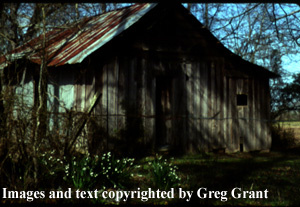
found naturalized throughout the South. My start came from an old abandoned
homeplace in East Texas. The delightful book Passalong Plants
(1993), by Steve Bender and the incomparable Felder Rushing, features
it among its collection of old, shared garden plants. Over the years,
more southern gardeners have probably referred to this plant as a snowdrop
than a snowflake. True snowdrops (Galanthus) are however a different
plant, and not real fond of Texas growing conditions.
Lest you think this plant
is only for old gardens and dead garden writers, it is much praised
by today's horticulturists as well. Scott Ogden, author of Gardening
Success with Difficult Soils (1992) and Garden Bulbs for the
South (1994) says "it is among the most reliable of spring bulbs
on limy ground."
The "summer" snowflake is
commonly available from mail order bulb catalogs and upscale garden
centers. A robust form known as 'Gravetye Giant' is offered as well.
It has the same clusters of dainty white bell shaped flowers highlighted
with green dots. Both the plant and the flowers are larger than the
common type, however, giving it a somewhat coarse appearance.
Anybody (both living and
dead) can grow snowflakes. As a matter of fact, they are quite common
in older cemeteries, where live plant material is still allowed. Although
snowflakes are tolerant of moist soils and often referred to as "moisture
loving," they will grow in any type of soil, wet or dry, sand or clay,
acid or alkaline. They will thrive in most light conditions but probably
prefer a bit of dappled shade. They are commonly grown in dense shade
as well. After ripening foliage in the spring the plant goes dormant
during the summer. As with all bulbs, it's very critical that the foliage
not be cut off while it is still green. This years foliage will be next
years flowers. As the foliage begins to wither the clumps may be lifted
and divided for propagation purposes. They don't' however require any
such division. I've personally found that they can be divided anytime
you want without much setback.
Snowflakes are great for
naturalizing in meadows and woodlands. They can also be clumped at the
base of trees and shrubs, scattered among mixed plantings, or used as
a border plant. One of the best ways to use snowflakes is to plant them
directly into groundcover beds such as Asian jasmine, liriope, and English
ivy. The pristine white flowers and glossy green foliage provide added
interest in the spring to otherwise nondescript areas.
Although we don't get alot
of snow in Texas, there's no reason we can't be blanketed with snowflakes
each spring. Their easy, their pretty, and they don't get your boots
wet.
At a Glance:
Botanical name: Leucojum
aestivum
Common name: Snowflake
Height: 1 foot
Exposure: Shade to sun
Water: Low
Use: Perennial, bedding,
naturalizing
Sources:
McClure and Zimmerman
108 W. Winnebago, P.O. Box
368
Friesland, WI 53935. #414-326-4220.
Daffodil Mart
Route 3, Box 794
Gloucester, VA 23061. #804-693-3966.
|